We’re refreshing our website so you might notice some changes as they go live, but everything you need is still here.

We’re refreshing our website so you might notice some changes as they go live, but everything you need is still here.
At Macsa id, we assess the glass composition, colour, curvature, code content and production conditions. As a result, we can define a marking process that prioritises code legibility, packaging integrity and line efficiency.
Glass is not a single substrate. Bottle thickness, surface treatments, mould marks and container shape can all affect the final result. Therefore, we test the real container before implementation.
A permanent mark only adds value if operators, consumers or scanners can read it correctly. The code must remain clear in the intended location and under the real conditions of use.
Laser systems can mark bottles, jars, perfume containers, pharmaceutical vials and other glass formats. Curvature, wall thickness and available coding space influence the choice of optics, marking position and settings.
For this reason, we evaluate the real container rather than relying only on its dimensions or material description.
Laser marking can apply:
If you use 2D codes for traceability, define the content, size and reading conditions in line with applicable GS1 standards.
The right laser source depends on the glass type, desired appearance, code size and line speed.
CO₂ laser technology is commonly used for coding glass bottles, jars and containers. It can create a visible frosted or white mark on suitable glass surfaces.
This makes it a strong option for date codes, batch information, logos and traceability data. However, the final contrast depends on the glass composition, colour and surface condition.
Macsa id can assess UV laser technology for applications that require fine detail, controlled interaction with the surface or a specific visual result.
UV systems may be suitable for selected glass types, coatings and precision applications. Nevertheless, a test is essential because transparent, coloured and treated glass can respond differently.
Clear, amber, green, frosted and coated glass do not react in the same way. Consequently, a code that appears clear on one container may not deliver the same contrast on another.
Macsa id tests the mark on the actual bottle, jar or vial to confirm the most suitable technology and settings.
Small codes, curved surfaces and limited coding areas require careful design. For example, Data Matrix and QR codes need sufficient contrast, module size and clear space for reliable scanning.
The final location should also allow the code to remain visible after filling, capping, labelling and handling.
Line speed, product spacing, vibration, condensation and working distance can influence marking quality. Therefore, the laser system must be configured for the real production environment.
Glass laser marking supports identification, traceability and product presentation across a wide range of sectors.
Typical applications include:
Laser marking is a suitable option when a permanent, direct code is required on the glass surface. It does not use ink, ribbons or labels during the coding process.
However, inkjet or labelling may be more appropriate for certain code colours, packaging formats or line requirements. Macsa id evaluates the complete application before recommending the right technology.
Macsa id can integrate glass laser marking systems into bottling, filling, packaging and inspection lines. The configuration can include code management software, communication with production equipment and vision systems for code verification.
In addition, a complete laser installation requires appropriate guarding and fume extraction. These elements help maintain a safe and controlled working environment.


Take away detailed information for our SPA range. If you provide your email address, we’ll send contact details of your personal product advisor for any future questions.
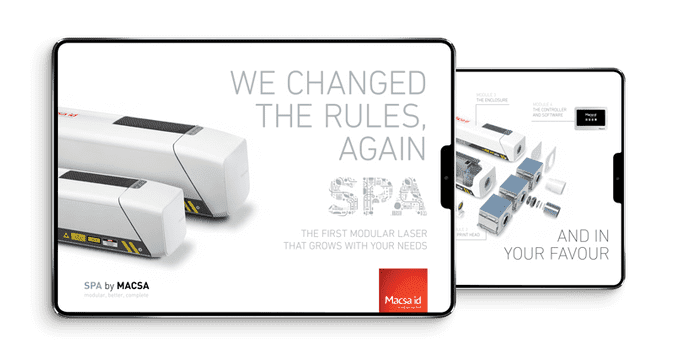
Take away detailed information about our coding, tracing and marking solutions.


