We’re refreshing our website so you might notice some changes as they go live, but everything you need is still here.

We’re refreshing our website so you might notice some changes as they go live, but everything you need is still here.
Flexible packaging can include single-layer or multi-layer structures made from plastics, paper, aluminium foil, coatings and printed layers. As a result, every pack responds differently to laser energy.
Macsa id evaluates the real film, coding window, artwork, code content and production conditions before recommending a solution. This approach helps protect packaging integrity while achieving a clear and readable code.
Laser coding is suitable for applications where variable information must be applied without physical contact. It can support packaging formats used across food, beverage, pharmaceutical, personal care and home care production.
Film laser marking can be assessed for:
Depending on the application, the system can mark:
If your 2D codes support supply-chain traceability, define their content and quality in line with applicable GS1 standards.
A clear code is only one part of the requirement. Film composition, print layers, coatings, colour, thickness, coding area and speed can all affect the result.
For this reason, Macsa id tests the application on the real pack. The test assesses code contrast, readability, packaging integrity and the parameters required for the line.
The laser marks the selected coding area without pressing against the pack. This is important for thin or delicate structures where contact-based processes may not suit the application.
However, no technology should be selected on the basis of the material name alone. The full film construction and the intended code area must be validated.
Laser coding creates the code directly on the appropriate surface or printed layer. Therefore, it does not transfer ink or thermal-transfer ribbon to the pack during production.
This can reduce consumable handling and remove ribbon-change interruptions on compatible applications.
Not every flexible film requires the same laser source. The correct option depends on material absorption, print design, desired contrast, coding speed and packaging requirements.
CO₂ laser systems can suit selected printed films, paper laminates and packaging applications. They are often considered for clear date, batch and traceability codes at production speed.
Nevertheless, the laser interaction must be tested on the actual film structure. The wrong settings may affect the appearance or performance of the packaging.
UV laser technology can be assessed for selected flexible plastics, including some recyclable and mono-material packaging structures. It may be appropriate where controlled interaction with the top layer and fine detail are important.
In addition, UV coding can offer an alternative to TTO for compatible films with a suitable coding area.
Fibre laser technology can be suitable for selected printed and metallised film structures. It is often evaluated when precise marking is required and avoiding unwanted perforation is critical.
For this type of application, explore the SPA2 Fiber Film solution.
Laser coding is not the best option for every flexible pack. It can be a strong choice when the film and coding area support a permanent, ink-free code.
However, TTO may be more suitable when the application requires opaque print on varied film colours, large graphics or dense information. Likewise, CIJ can be appropriate when the code must be applied after the pack has been formed.
Macsa id assesses the packaging, coding content and production line to recommend the most suitable technology rather than forcing a single solution.
Film laser marking systems can be integrated into horizontal and vertical form-fill-seal machines, flow-wrap lines, pouch lines, thermoforming equipment and other packaging systems.
The final setup depends on:
As a result, the laser configuration can support the production process without compromising access for operation and maintenance.


Take away detailed information for our SPA range. If you provide your email address, we’ll send contact details of your personal product advisor for any future questions.
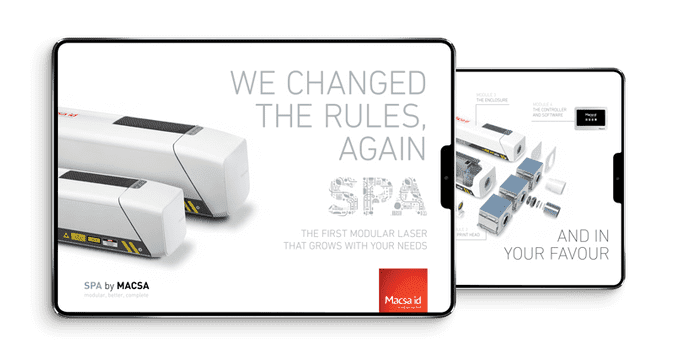
Take away detailed information about our coding, tracing and marking solutions.


