We’re refreshing our website so you might notice some changes as they go live, but everything you need is still here.

We’re refreshing our website so you might notice some changes as they go live, but everything you need is still here.
At Macsa id, we configure laser marking solutions according to the aluminium alloy, surface finish, required contrast, code content and production cycle. The aim is to achieve a readable, durable mark that fits the production process.
Raw, anodised, painted, coated and lacquered aluminium can react differently to the laser. For this reason, we assess the real component or packaging sample before defining the technology and marking parameters.
Laser marking and laser engraving do not always produce the same result.
Laser marking creates visible contrast on the surface or on a treated layer, making it suitable for serial numbers, codes, logos and product references. Laser engraving removes a controlled amount of material to create a deeper mark when increased resistance is required.
The most appropriate process depends on the intended use of the part, the surface finish and the required durability of the code.
Laser systems can apply fixed or variable information directly onto aluminium parts and products without ink, labels or physical contact.
Typical applications include:
Where 2D codes are used for supply-chain traceability, their data structure should be defined in line with applicable GS1 standards.
Fibre laser systems are commonly used for marking aluminium components, nameplates and technical parts. They can create serial numbers, texts, logos and 2D codes with high precision and are suitable for automated production environments.
MOPA fibre laser technology provides additional control over pulse parameters. It can be evaluated when the application requires specific contrast, fine detail or controlled marking on selected anodised or treated aluminium surfaces.
UV lasers can be considered for coated, treated or heat-sensitive applications where reduced thermal impact and fine detail are important.
CO₂ lasers may be suitable for selected coated, lacquered or packaging applications. However, they are not a universal solution for bare aluminium. The material, coating and intended coding area must always be tested before implementation.
Raw aluminium is widely used for machined parts, housings, tools and industrial components. Depending on the alloy and required result, laser marking can create contrast marks or light engraving for identification and traceability.
Anodised aluminium is often used for control panels, enclosures, nameplates and cosmetic components. The anodised layer can provide strong visual contrast, but the result depends on its colour, thickness and finish.
Painted, coated and lacquered aluminium requires careful process selection. The laser may interact with the top layer rather than the base material, so contrast, adhesion and readability should be validated on the real part or pack.
Macsa id laser systems can be integrated into automated production lines for dynamic marking or configured in iLaserBox workstations for static parts, lower-volume production and semi-automatic operations.
The final configuration can include software, vision systems, positioning, code verification and communication with production equipment. We define the solution according to the available space, cycle time, automation level and safety requirements.


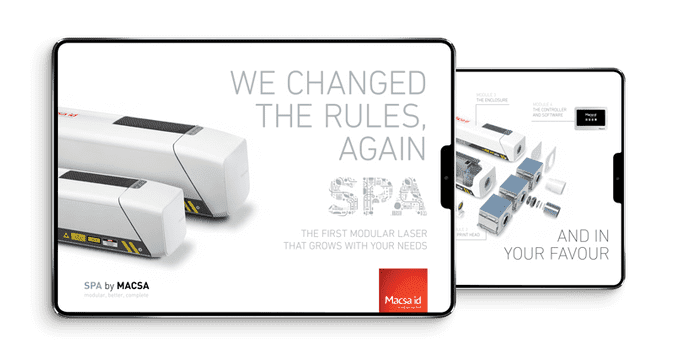
Take away detailed information for our SPA range. If you provide your email address, we’ll send contact details of your personal product advisor for any future questions.
Take away detailed information about our coding, tracing and marking solutions.


