Pet food coding and marking needs to work reliably across bags, pouches, cans, trays and outer cases. Macsa id UK helps manufacturers apply clear best-before dates, batch information, production data and 2D traceability codes at the speed their lines require.
Whether you produce dry food, treats, wet food or specialist diets, the right solution starts with the actual pack. We assess the material, coding area, code content, line speed and production environment to recommend the technology that best fits your operation.
Reliable coding for UK pet food production
A small date or batch code carries significant operational value. It must remain clear through filling, sealing, handling, storage and distribution, while the correct data needs to be applied consistently at every product changeover.
Macsa id UK provides coding, marking, labelling and verification solutions for pet food manufacturers. Our systems can be configured around the packaging material, available coding window, artwork, line speed and real conditions of the production line.
Code the information that matters
Pet food packaging can carry a wide range of variable information, including:
- Best-before dates.
- Batch, lot and production numbers.
- Production date, time, line or shift data.
- Product references and internal traceability information.
- Linear barcodes, QR codes and Data Matrix codes.
- Retailer, warehouse or promotional information.
Macsa id helps manufacturers apply and verify the variable data defined by their quality, operations and regulatory teams.
Coding for every pet food packaging format
Dry food bags, treat packs and paper sacks
Dry pet food and treats are packed in a broad mix of paper sacks, laminated bags, block-bottom bags, flow-wraps and printed films. The coding solution must deliver sufficient contrast without compromising the pack design or slowing the line.
Pouches, retort pouches and flexible films
Wet food pouches, retort pouches, sachets and flow-wraps can be complex to code. Film structure, print layers, coatings, seals and the available coding area all influence the final result. The code needs to remain readable without affecting the appearance or integrity of the pack.
Cans, trays, tubs and lids
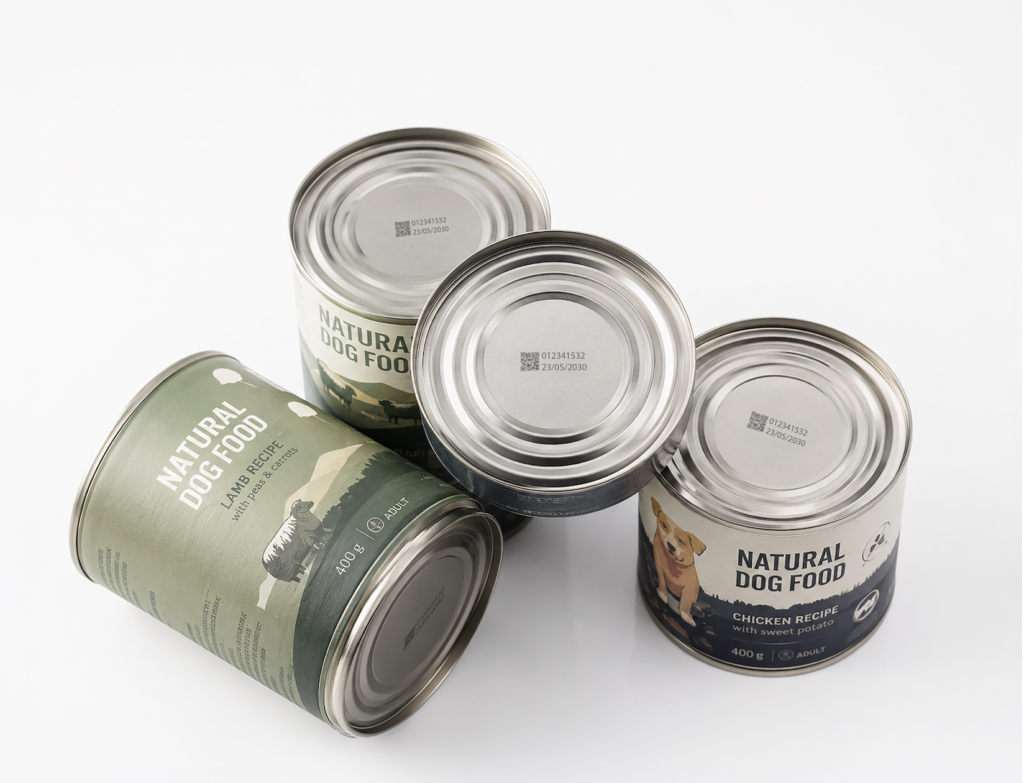
Wet pet food is commonly packed in coated metal cans, aluminium trays, plastic tubs and lidding materials. Curved surfaces, coatings, coding position and downstream handling must all be considered before selecting the coding method.
Outer cases and pallet labels
Secondary packaging needs to support efficient identification in the warehouse and supply chain. High-resolution inkjet, laser marking and print-and-apply labelling can be assessed for outer cases, shrink-wrap and pallet identification.
Choose the right technology for the real pack
There is no single coding technology that suits every pet food application. Macsa id UK recommends the solution according to the final packaging sample, code content and production conditions.
iLumiFlex: a UV laser alternative to TTO for compatible films
iLumiFlex is designed as an alternative to thermal transfer overprinting on compatible flexible packaging. It creates permanent variable codes directly on the film without ribbons, inks or thermal printheads.
For suitable pet food bags, pouches and film applications, iLumiFlex can help reduce ribbon-change interruptions and consumable handling while maintaining clear date, batch and traceability coding. Every application should be validated using the final packaging material.
Laser coding matched to the substrate
CO₂, UV and fibre laser technologies can be evaluated for selected films, paper and board, printed surfaces, cartons and metal packaging. The correct laser source depends on the substrate, coating, desired contrast, code size and line speed.
Laser coding is not automatically the right choice for every pack. The final decision should be based on the material and the required result, not on the packaging category alone.
Inkjet and labelling solutions for flexible applications
Inkjet and labelling solutions can be a practical option where the application requires specific contrast, a limited coding area, a curved surface or variable secondary-packaging information. Macsa id UK can assess these options alongside laser technology to define the most suitable process.
Built around real pet food production conditions
Pet food production can present demanding coding environments. Dry food and treat lines may generate airborne dust, while wet food lines can involve moisture, heat, residues and cleaning processes. Packaging may also change regularly as brands introduce new artwork, materials or recyclable structures.
Macsa id UK considers the real line environment before recommending a system, including product spacing, available installation space, code position, extraction, access for operators and the integration required with existing equipment.
Protect code quality at every changeover
A readable code is only part of an effective traceability process. The variable information also needs to be correct.
Macsa id software can connect coding equipment with production data to reduce manual data entry and help ensure that the correct message is sent to the right line. Where required, Integra Vision can support in-line inspection of code presence, position and content before product leaves the factory.
Validate every new pack before line approval
New films, coatings, print designs and recyclable packaging structures can change how a code performs. Before approving a new coding process, Macsa id UK tests the real packaging sample, the final code content and the expected production conditions.
This validation can assess code contrast, readability, available coding area, repeatability at line speed, visual appearance and the effect of the process on the packaging structure.