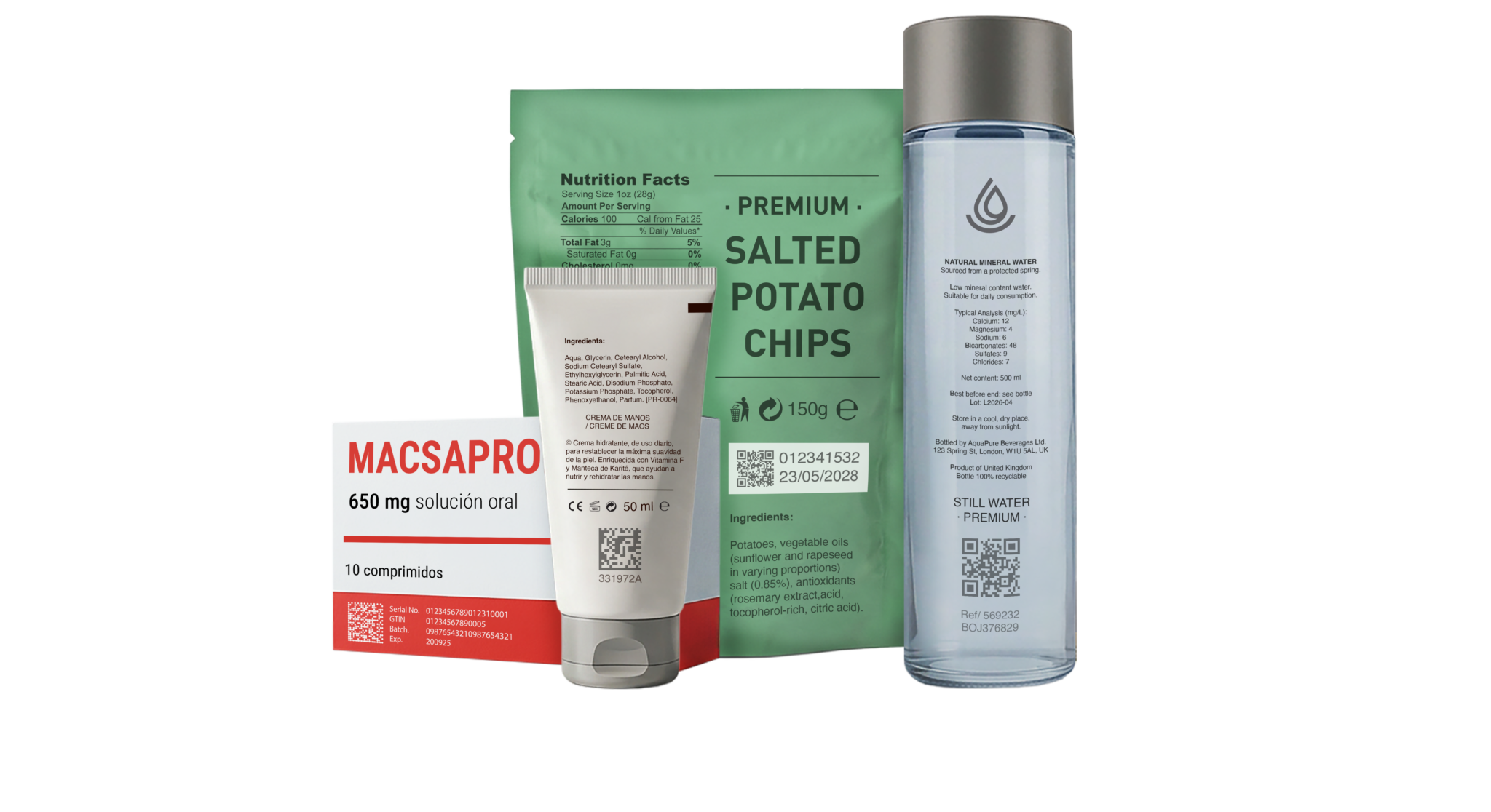
Food packaging coding is essential for UK manufacturers managing date marks, batch information and product traceability. A clear, accurate code helps businesses identify products throughout the supply chain and respond effectively when an issue arises.
In the UK, food businesses must keep traceability records that allow food to be tracked through the supply chain and support the rapid withdrawal or recall of unsafe products.
This means that a code must do more than appear on the pack. It needs to remain accurate, legible and linked to the information systems that support the product throughout its journey.
What information needs to be identified on food packaging?
The exact information required depends on the product, packaging format and route to market. However, manufacturers commonly need to manage:
- Batch or lot codes.
- Use-by or best-before dates.
- Production dates and times.
- Product references.
- Line or shift information.
- Barcodes and, increasingly, 2D codes.
A batch code is particularly important when identifying the scope of an issue. In the event of a food incident, businesses may need to provide details such as product name, pack size, date mark and batch code to help determine which products are affected.
Traceability is a system, not simply a printed code
A legible code on a pack is essential, but it is only one part of an effective traceability process.
The code should connect the physical product with the information held by the manufacturer: ingredients, supplier records, production date, line, operator data and distribution details. When this information is accurate and accessible, manufacturers can isolate an affected batch more quickly and avoid unnecessarily broad recalls.
For this reason, food coding should be considered alongside:
- ERP and production-management systems.
- Line-change procedures.
- Data validation.
- Code inspection and verification.
- Recall and withdrawal processes.
The Food Standards Agency’s guidance highlights the importance of maintaining effective traceability systems and regularly reviewing them.
Date coding: clarity matters on the production line and at retail
Date marks are among the most visible pieces of information on food packaging. A missing, incorrect or unreadable date can lead to rejected products, retailer complaints, waste and costly rework.
The coding solution must be able to apply variable data consistently at the required line speed, even when packaging formats, materials or production conditions change.
Common challenges include:
- Condensation in chilled and frozen-food production
- Curved bottles and jars
- Flexible film moving at high speed
- Low-contrast packaging designs
- Limited space for coding
- Abrasion during handling, transport and retail display
The goal is not simply to print a date. It is to make sure that it remains clear and readable at the point where it matters.
Packaging changes can affect code quality
Packaging is changing rapidly as manufacturers review material choices, recyclability and pack weight. In the UK, Extended Producer Responsibility for packaging requires relevant organisations to report packaging data, including recyclability-related information.
While EPR does not prescribe a coding technology, new films, coatings, labels and recycled-content materials can change how a code performs on the line.
Before approving a new pack, manufacturers should test:
- Contrast between the code and substrate
- Adhesion or permanence of the mark
- Resistance to handling, moisture and abrasion
- Available coding area
- Readability at normal line speed
- Performance after filling, sealing and distribution
This is especially relevant for flexible packaging, beverages, chilled foods and frozen products, where the coding environment can be demanding.
Are 2D codes required on UK food packaging?
There is no general legal requirement for every food manufacturer to replace existing barcodes with 2D codes.
However, 2D codes can support broader traceability and consumer-information initiatives by carrying or connecting to more data than a traditional linear barcode. For manufacturers, the immediate priority is to ensure that any code used on-pack is appropriate for the application, readable in the supply chain and compatible with the relevant retailer or customer requirements.
The choice between a linear barcode, QR code, GS1 DataMatrix or another format should follow the operational and commercial need—not a one-size-fits-all approach.
How to improve coding reliability in food production
A robust coding process starts with three questions:
- What information must this product carry?
Consider date marks, batch data, product references and customer-specific requirements. - Will the code remain readable throughout the supply chain?
Test it after sealing, cooling, freezing, handling and transport—not only at the point of print. - Can the line prevent coding errors before product leaves the factory?
Use controlled data entry, production-line integration and inspection where appropriate.
At Macsa id UK, we help food manufacturers select coding and marking solutions that suit their packaging material, line speed and traceability requirements—from flexible films and cartons to bottles, trays and secondary packaging.