The EU’s new Packaging and Packaging Waste Regulation (PPWR) marks a significant overhaul in European packaging standards with a focus on sustainability: minimising packaging, improving recyclability and increasing the use of recycled material. While the United Kingdom is no longer an EU member, the PPWR has direct and wide-reaching consequences for UK-based manufacturers, exporters, and importers integrated with European markets.
What is the PPWR?
The PPWR is a sweeping regulation intended to:
Make all packaging recyclable by 2030 using established collection and recycling infrastructure
Reduce packaging waste per capita, with focused targets for plastics and unnecessary materials
Establish mandatory recycled content thresholds, especially for plastics
Implement strict reuse targets for sectors such as e-commerce and food service
Standardise labelling to provide clear disposal instructions for consumers
Unlike its predecessor—the Packaging Waste Directive, which allowed for national interpretation—the PPWR brings uniform rules into force simultaneously across all EU member states, beginning 12 August 2026
Implications for UK Businesses
Export Compliance with EU Standards
UK businesses exporting goods to the EU must ensure all packaging—whether primary, secondary, or tertiary—is compliant with PPWR. This covers material composition, recyclability, use of recycled content, and labelling requirements. Non-compliance could lead to delayed shipments, rejected goods, or penalties.
Changing Import Packaging
As EU suppliers transition to PPWR-compliant packaging, UK importers will encounter changes in:
Packaging formats and materials
Labelling
Handling, storage, and disposal processes
Automation and logistics systems may require updates to accommodate these changes.
Stronger Supply Chain Integration
The regulation demands close coordination throughout supply chains. Failures in compliance at any stage—including component suppliers or logistics partners—may disrupt the entire chain. Contracts, audits, and supplier relationships will increasingly factor in packaging compliance criteria.
Rising Consumer and Retail Expectations
UK businesses lagging behind PPWR principles could lose retail listings or customer trust, even if not directly exported to the EU.
Key Regulatory Requirements
Area
PPWR Requirement
UK Business Impact
Recyclability
All packaging must be effectively recyclable by 2030
Rethink material choices and avoid complex composites
Recycled Content
Mandated: eg. 30% for some plastics, rising over time
Secure certified recycled materials and ensure traceability
Waste Reduction
Targets for reducing all packaging and plastic packaging
Certain single-use and non recyclable formats prohibited
Redesign products/packages as needed
Compliance Solutions for Coding, Marking, and Traceability Providers
At Macsa id UK, our extensive range of coding, marking, and traceability solutions is designed to help your business seamlessly adapt to evolving regulatory requirements, such as the PPWR. Beyond basic compliance, PPWR demands operational transformation of coding systems. Legacy equipment may lack the data integration capabilities needed for real-time batch tracking and recycled content verification that the regulation requires.
Here’s how our offering supports UK and EU compliance:
Advanced hardware: High-precision laser, inkjet, and labelling systems compatible with all packaging materials, from product to pallet.
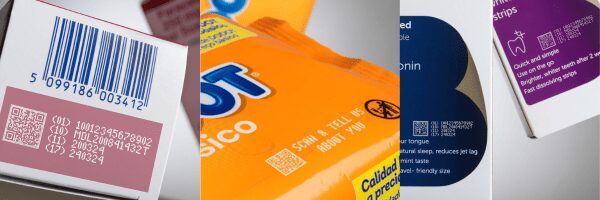
Integrated software: Smart solutions for adding essential product identification, batch codes, best-before dates, and recycling instructions—essential for compliance with harmonised EU labelling.
End-to-end traceability: Robust supply chain traceability, securing the integrity and transparency demanded by both regulators and clients.
Optimised efficiency & sustainability: High-speed equipment for the most demanding applications reduces operational costs and supports reduced packaging footprints.
Consultative support: Expert guidance to tailor coding and marking technologies for sustainable packaging and dynamic regulatory landscapes.
Implementation Timeline for UK Businesses
Now: System Preparation
Assess current packaging and coding capabilities against PPWR requirements
Upgrade coding systems for enhanced data integration and traceability
Secure certified recycled content suppliers and establish verification processes
Begin testing PPWR-compliant packaging formats and labelling
September 2025 - July 2026: Final Preparation
Complete packaging redesigns for recyclability compliance
Test compliance packaging with EU distribution partners
Train teams on new coding systems and compliance requirements
Coordinate transition timelines with EU customers
August 2026 onwards: Full Implementation
Switch all EU exports to PPWR-compliant packaging
Activate comprehensive traceability and compliance monitoring
Implement ongoing regulatory monitoring and system updates
Why Act Now?
Businesses that proactively align with PPWR requirements will be positioned to:
Maintain frictionless access to EU markets
Strengthen customer and partner trust through transparent sustainability
Avoid rushed changes and costs associated with delayed compliance
Build operational systems that satisfy not only EU but also UK and global standards
Early movers will enjoy a strategic advantage—future-proofing packaging operations for a rapidly evolving regulatory and consumer landscape
At Macsa id UK, we are large enough to innovate but small enough to care. Let us help your business navigate the challenges and unlock the opportunities of the new PPWR.
Next 29th and 30th of November, the 15th edition of Empack Madrid will take place. At this event, you will be able to travel to the future of the packaging sector and discover the latest trends in design and innovation...
Companies in various industrial sectors are incorporating equipment and traceability systems that automate their production process tasks. Knowing the origin and path a product has taken until it reaches the consumer is synonymous with the guarantee, quality and transparency that an industrial traceability system provides nowadays. In order to increase the efficiency and profitability of this system, Macsa id has launched SPARK; a new laser that offers innovative features that provide high reliability at a very competitive price along withhigh quality. This is a clean and intelligent CO2 laser coder that allows the coding of small characters on the key materials and substrates used in the packaging industry for different sectors.[contact-form-7 id="16985" title="Contact form - Inboud Colours - Post SPARK Catalogo English"]
Why is SPARK sustainable?
The SPARK laser is a green, 100% sustainable machine because it:
Consumes less energy than inkjet coders.
Generates zero waste.
Reduces emissions and lowers your carbon footprint.
Eliminates the need to recycle potentially harmful waste products.
Reduces operating costs by eliminating the need for consumables, inks and solvents.
Makes the production lines themselves environmentally friendly.
Facilitates a clean and hygienic working environment.
Choosing the SPARK laser is also a smart choice because:
The new interface technology is more than just a touch screen; it is the gateway to a multitude of functions: from full control of all the laser's features, to vital information related to your production line.
It combines intuitive software with online video tutorials, allowing operators with no prior technical knowledge to quickly and easily unlock the full potential of the machine.
It is incredibly easy to use, with the fastest and easiest message creation software on the market. New templates reduce message creation time by up to 50%.
It is compact, lightweight and easy to connect. The new wizard reduces setup time, avoiding the trial and error method of other equipment.
It is easy to integrate, as the new digital galvos and controllers together with the new dual processor makes it easy to integrate, even for the most demanding production lines.
It is easy to connect, as its multiple options enable easy ethernet connectivity to control and manage the equipment remotely.
It is easy to manage thanks to Integranet 4.0 software, which allows remote data and equipment management, production line efficiency monitoring and maintenance planning.
It is fast because the laser uses high-performance lenses, powerful hardware and advanced software that enables high speeds on packaging production lines.
SPARK is revolutionary because as well, as the aspects described above, it is a quality laser at a very competitive price. After little more than a year, the laser will have cost less than an inkjet system. In addition, and thanks to its advanced laser technology, SPARK is keeps maintenance costs to a minimum. For all these reasons, it is a real innovation in the packaging sector, both nationally and internationally.
A laser for most consumer packaged products
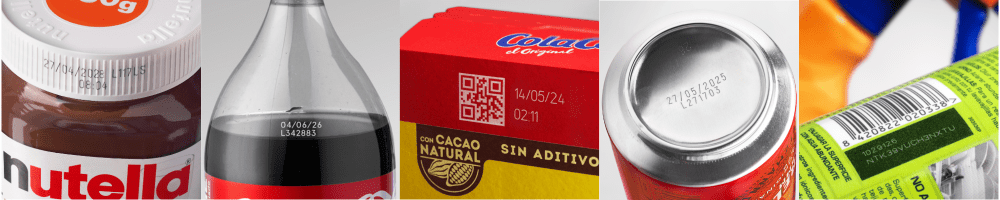
The SPARK laser allows small character coding on materials and substrates such as cardboard, glass, organic, PET and wood, across a wide variety of industries.The laser marking provided by this equipment is permanent, sustainable and indelible. In this way, the printed code cannot be altered or manipulated, ensuring product traceability throughout the manufacturing process and supply chain. This kind of marking is ideal for preventing counterfeiting and ensuring brand and product protection.As such, SPARK provides the highest quality legible marks throughout the product shelf life and is the best laser for the following production environments:
Food: coding on packaged food products: fresh and frozen, single and multipacks.
Pharmaceutical: meets the quality standards of the pharmaceutical industry serialisation requirements for coding labels, products, tubes and boxes.
Beverages (water, wine, spirits and soft drinks): All beverage containers can be coded with SPARK, whether they are made of PET, glass, paper, labels or cardboard.
Personal Care: discreet, accurate and high quality coding for the entire range of personal care products.
Home Care: high speed and high contrast for household care and cleaning product packaging.
The new SPARK laser and its complete range of accessories is the result of 35 years experience, know-how and innovation of the company; qualities that have made Macsa id one of the five leading companies in the world specialised in coding and traceability with laser marking. This leadership position is maintained thanks to the investment of 10% of its annual turnover in R&D&I.Making innovation one of the company's strategic keys has enabled Macsa id to register 30 patents, which have led to some of the most important advances in the industry. Some examples include the first dynamic laser for coding on dynamic production lines (1990) and the first fibre laser for in-line coding (2009).Today, Macsa id provides its customers with a broad portfolio of solutions related to their coding, identification and traceability needs, combining a extensive range of hardware and software technology, services, consumables and other supplies.This innovative range, both offline and online, is the widest in the industry and has been designed to provide the best laser marking solutions for manufacturers in industrial sectors such as automotive, medical, pharmaceutical, cosmetics, engineering, electronics, jewellery, security, promotional items, as well as defence and aerospace construction.Different sectors require different materials to mark and code on: metal, plastic, film, steel, stainless steel, titanium, carbides, resin, silicone, gold, silver, platinum, PFTE, aluminium, PVC, ceramics, chrome, ABS, chrome, wood, organic.Another fundamental strategy for the development of Macsa id's business has been its orientation towards internationalisation. This strategy led to having subsidiaries in 4 countries and to operating its equipment and services in more than 90 countries, thanks to a wide network of distributors that extends over 5 continents. This wide area of operations is key to offering a comprehensive service to its customers and providing a personalised response to emerging needs in the field of product coding and traceability.
Macsa id will be delighted to find the marking, coding and traceability solution that best suits your needs
The new edition of Interpack will be held from 4th to 10th May in Düsseldorf. This is a new opportunity to bring the entire global packaging industry together, as well as stay updated with technological developments, innovations and sustainable packaging trends for the food and beverage, confectionery, bakery, pharmaceutical, cosmetics and industrial goods sectors.We will be present at stand G58 in Hall 8B at Messe Düsseldorf, with our latest innovation, the best coding and laser marking solution for carbon footprint reduction.
The most complete range of packaging lasers. The following will be on show:
SPA2 C, used in high speed applications for packaged products. They provide the highest quality, permanent, sustainable and legible markings for every production environment. This laser is suitable for a wide variety of substrates such as cardboard, glass, ceramic, PET and PVC.
SPA2 F Pulsed, a solution for high quality, permanent, sustainable and legible metal marking for all production environments. This laser can mark a wide variety of materials, such as plastics and metals.
SPA2 F Film, reliable laser for marking and coding film and flexible packaging without perforating the packaging.
SPA2 D Green UV, solid-state laser used for packaged goods applications, typically for coding plastics. The UV version allows coding of special materials and marking with minimal thermal impact, making it ideal for marking delicate materials. Ideal environments for this version are standard and humid environments.
SPA2 WD is the most versatile laser in the range, as it can be easily integrated into any production line and can code a wide variety of materials, such as paper, cardboard, glass, ceramics, PET and PVC...
The current fastest ultra high speed QR coding laser, BiDiLase. The only laser on the market capable of doing what others still dream of: super speedy coding; maximum marking precision; unique, ultra high speed serialisation; full production line integration; unique digital passports; greater production control to guarantee traceability; clean and waste-free.
idTIJ and idJET, the high-resolution industrial inkjet printers capable of printing on all types of materials.
The new Green, Smart & Revolutionary laser for 100% sustainable small characters. It is the best coding and marking solution to reduce your carbon footprint and it will be shown for the very first time at Interpack 2023.
Interpack 2023 is just around the corner and we are looking forward to sharing our new laser coding and marking solution for even greater sustainability.
Would you like to visit Macsa at the Interpack stand?
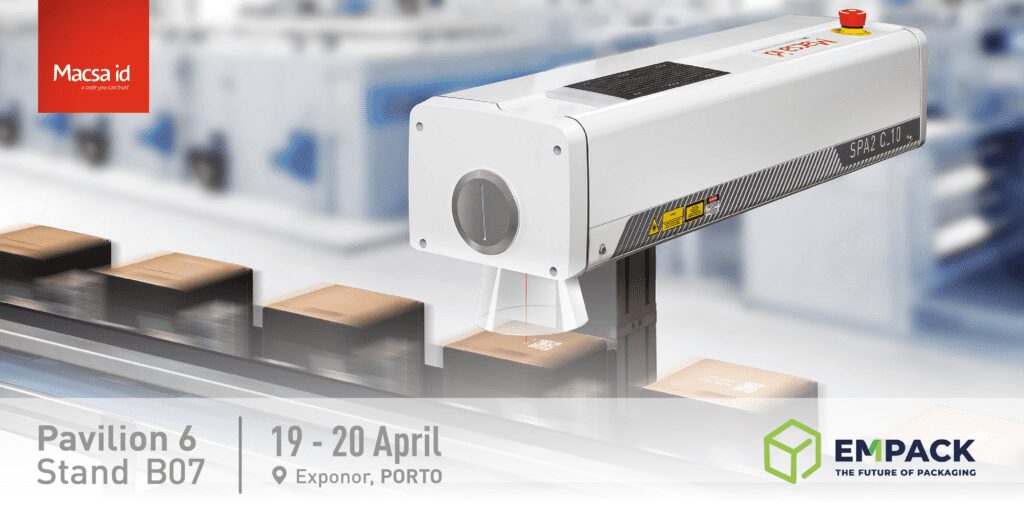
The 7th edition of Empack Oporto will be held on 19th and 20th April at the Fira Internacional do Porto, Portugal. This is an opportunity to bring together professionals from the sector with multiple suppliers. In addition, you can learn about the latest technological developments in the packaging community: through showrooms, conferences and innovation tours, allowing you to discover the future of the logistics industry.We will be at stand B07 in Pavilion 6 of Exponor, Fira Internacional Do Porto, with the latest solutions in coding and traceability 4.0 for the security of your products and customer peace of mind.
Invitations are available for you to attend Empack Oporto
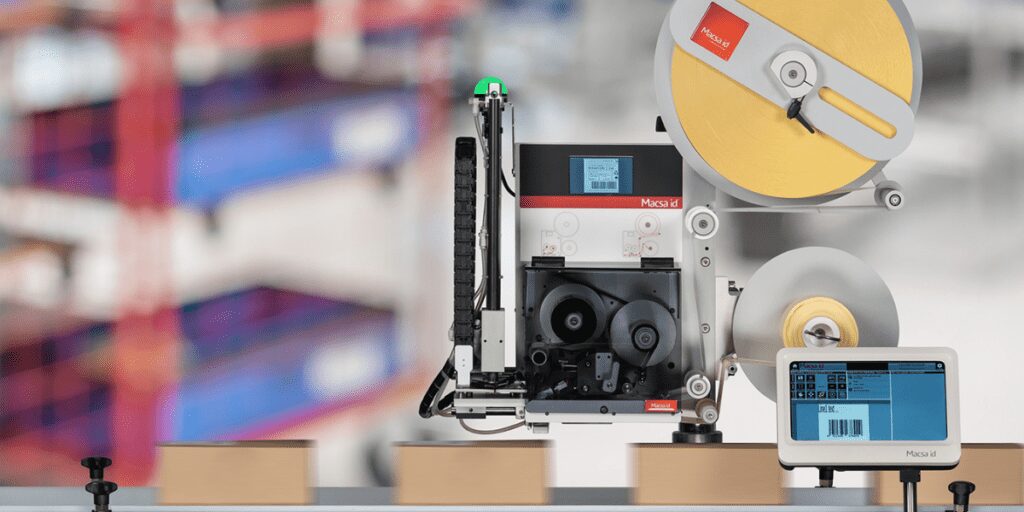
The industrial labelling machine with linear pneumatic cylinders that allows labels to be applied to surfaces of different lengths. The linear MLPE 4020 from Macsa id has been designed with a high power overlapping system to guarantee good label application.
The SPA2 C 30W range of CO2 lasers are used in high speed applications for packaged goods such as cartons, bottles and blister packs. They provide permanent and sustainable markings that are legible and of the highest quality. It is relevant for all production environments and for a wide variety of substrates such as cardboard, glass, ceramic, PET and PVC in the FMCG markets.
The SPA2 Pulsed Fibre for coding in the packaging sector. A solution for legible, high quality, permanent and sustainable marking on metals in all production environments. These lasers can mark a wide variety of substrates, such as plastics and metals, in the FMCG markets.
SPA2 DPSS UVsolid state lasers used for packaged goods applications, typically for coding plastic substrates. The UV version allows special materials to be coded and marked with minimal thermal impact, making it ideal for marking delicate materials. Ideal environments for this version are standard and humid environments.
idTIJ and idJET; the high-resolution industrial inkjet printers capable of printing on all types of materials.
Linx 8900; the high-performance inkjet printer that helps maximise efficiency during production, saving on costs and time. The versatility of the 8900 series printers makes them suitable for coding across multiple markets and substrates.
Empack Oporto 2023 is just around the corner and we are looking forward to sharing our latest solutions in coding and traceability 4.0 with you at the show.
Would you like to come and visit Macsa at the Empack Portugal stand?
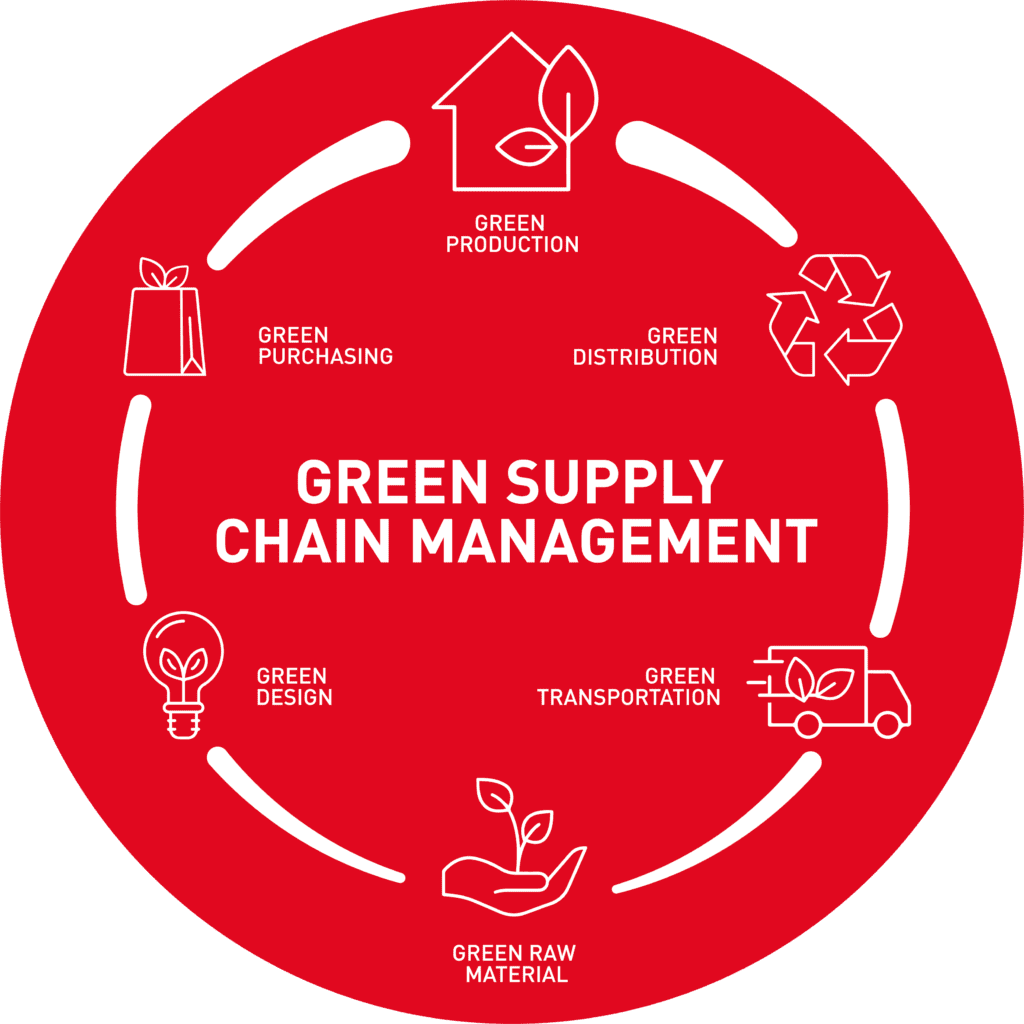
The term 'Green Supply Chain management' (GSCM) refers to the concept of integrating sustainable environmental processes into the traditional supply chain. This can include processes such as product design, material sourcing and selection, manufacturing and production, operation and end-of-life management.
In recent years, research in the area of green manufacturing has extended into green supply chain management. Achieving highly responsive, sustainable supply chain performance is the key to securing a competitive advantage, as well consumer loyalty and long-term business success.
Organizations worldwide are acutely aware of this, but implementing green supply chain management is no simple task. Traditionally, supply chain management has been about cost and quality. Growing concern for the environment has forced a rethink.
In this article you will get an overview of the challenges it involves and Macsa id’s comprehensive solution to get along in this new scene.
Green supply chain management is an approach that integrates eco-friendly methods into traditional supply chain management. Its goal is to reduce the harm incurred at every stage of product creation—purchasing, production, material management, distribution, and logistics.In short, the environmental aspect must be a component in all stages of a product's life, from its design, to its eventual recycling.
The Cycle of Green Supply Chain
2. The challenge with conventional packaging solutions
Conventional print methods struggle to offer brands the flexible and agile solutions they need to meet these varying packaging demands effectively. Traditional manufacturing processes are intended for mass production and require high volume minimum orders of identical boxes, labels, or retail displays to be cost-effective for the brand and the manufacturer.
3. Benefits of using laser printers
The rising adoption of digital printing and marking technology in food and beverage packaging, consumer goods packaging, and industrial packaging, is propelling the market towards laser printers in the food and FMCG segment.Laser printing provides precise, high-quality text and graphics on various packaging materials. It is an ideal solution when you need custom printed labels for your products, promotional items, on a wide variety of packaging surfaces.Laser markings are completely permanent. They are engraved onto the surface of the item, which is a huge bonus for laser marking.
Laser printers guarantee:
High-quality Print
Precision
Flexibility
Durability
Versatility
Safety
Near-Zero Maintenance
The Macsa id SPA2 Can Coding
4. The Macsa id solution
Macsa id’s packaging lasers achieve high quality marking on any packaging material from cardboard, glass or PET to polystyrene. They require no consumables, making them environmentally friendly and cost effective to run.Macsa id provides laser marking solutions which are compact for production line environments, but also offers modular options for flexible integrated applications, with both options being highly reliable and requiring little maintenance.To explore Macsa id’s range of laser printers just click here.
At Macsa id we will be happy to find the marking, coding and traceability solution that best suits your needs:
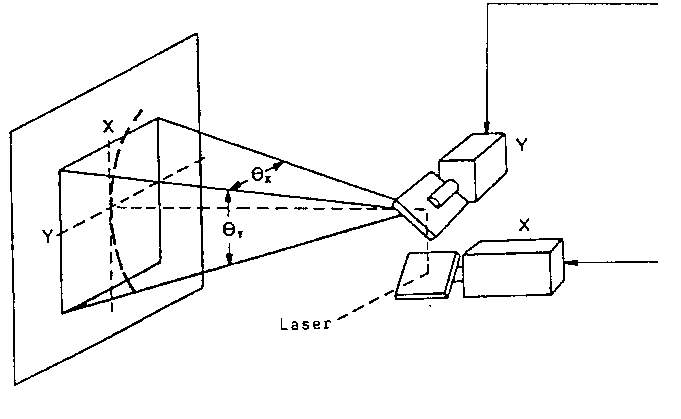
The method that is typically used in laser systems utilizes an optical system of galvanometric scanners. Because the laser beam has no mass, limitations on speed and accuracy are imposed by the movements of the mirrors that guide the laser beam.Beam control is achieved using a set of two X-Y mirrors connected via an axis to the galvanometer scanners, which is in turn controlled by drivers receiving signals from the laser CPU. This provides a pair of polar coordinates converted to Cartesian coordinates by positioning the laser beam in an X-Y plane.The beam exits through the opening of the laser tube and is directed at the marking surface via the mirrors and focal lens.Each movement of the mirrors corresponds to one of the axes (X or Y) and is positioned according to the X-Y coordinates of each of the points of the printed message.These galvanometric scanners have built-in mirrors that reflect the laser beam onto the marking surfaces. The mirrors have a high reflectivity index at the particular laser wavelength to provide maximum beam power.In the case of dynamic marking, the mirrors follow the product as it moves down the production line while the message is being marked. Figure 1: Example of an optical system with galvanometer scanners
2. 3D technology
For 3D marking currently there are different technologies, but these can be divided into 2 main groups: Displacement lenses These optical systems in 3D laser marking heads entail the introduction of a new displaceable lens in addition to one, two or more fixed focal lenses. These lenses are placed in the optical path between the laser tube aperture and the X-Y galvanometric scanners.The usual operation of these systems is as follows:The laser beam exits the laser tube aperture and hits the displaceable lens. The function of this lens is to shift the laser focal spot around the focal plane by moving along an optical axis. This causes a change in the divergence angle of the laser beam.Once the laser beam has passed through the displaceable lens, it passes through one, two or more focal lenses that deal with focusing. It then reaches the laser deflection unit, which is where the X and Y galvanometer scanners are located. As already explained above, the task of the scanners is to guide the laser beam on the X-Y plane.If we focus on the 3D part of the optical path, the part with the new lenses, we can say that when the movable lens approaches the fixed lens, the focal length increases. Conversely, when the displaceable lens moves away from the fixed lens, the focal length decreases.To achieve high performance 3D marking, in addition to having a system with the components explained above, we will need the linear lens shift system to have a number of characteristics.For example, the lens displacement speed performance has to be very high, since the 3 axes (X, Y, Z) have to be coordinated to achieve perfect 3D marking.To attain good performance for linear lens displacement systems, different technologies have been explored. A few of these are explained below:
Galvanometer (Rotary Motor).
It works in the same way as galvanometers that control the motion of X-Y scanners. A galvanometer is based on and works like an electric motor.
Displacement systems can have 2 galvanometers, one on each side for higher speed performance.
Linear actuator (Linear motor)
These are motors that base their operation on the same physical principle as traditional rotary motors, but instead of having a rotary motion they have a linear motion due to the arrangement of their components.
Piezoelectric moto
These motors are considered linear but follow the piezoelectric principle in operation. This principle uses the deformation experienced in some materials when an electric current is applied to them. This deformation is converted into an ultrasonic vibration that moves the motor forwards/backwards.
Voice coil motor
This motor is based on a copper coil energized by an electric current and placed inside a magnetic field generated by permanent magnets. The force generated by the coil is proportional to the magnetic field and to the direction and magnitude of the electric field. As there are no components in contact, there is no wear or friction and it is suitable for high speed applications.
All these linear lens displacement systems will normally be controlled by drivers connected to the central CPU of the laser system.In addition to the above, depending on the application of the 3D laser marking system, an F-Theta lens may or may not be included. The function of these lenses is to ensure the same focal length over the entire marking area. Focus-tunable lens The 3D technology we are going to explain below is based on physical properties to control the Z-axis.The electrically focus-tunable lens is a flexible lens that can change its shape. This lens consists of a polymer membrane surrounded on one side by a type of liquid and on the other side by air. Finally, it is encapsulated by protective glass.The lens works as follows: If the pressure difference between liquid and air is altered by means of an electromagnetic actuator, the radius of curvature of the membrane can change.In the marking head, these tunable lenses are positioned between the laser tube aperture and the X-Y galvanometer scanners. Their function in the optical path is the same as that of the displaceable lens, i.e. to control and change the position of the Zaxis.As in the previous case, depending on the application, an F-Theta lens may or may not be added at the end of the optical path.If it is added, its function is to ensure the smoothing of the marking area and the function of the tunable lens is to change the divergence of the laser beam to achieve a focus shift in the Z-axis.If the F-Theta lens is not added, the two functions discussed above must be performed by the tunable lens.The tunable lens is controlled by a driver connected to the laser system's CPU and allows real-time control in conjunction with the X-Y scanners to achieve perfect 3D marking.
3. Other Z-Axis Control technology
Apart from laser marking for 3D objects, it is sometimes necessary to control the Z-axis but at lower output, for example when marking an object with different planes at different heights.In this application the Z-axis has to go up/down, but it does not have to do it in coordination/real time with the X-Y scanners. In other words, the Z-axis does not have to go as fast as in 3D laser marking systems.For these applications there is also a wide range of technology, but we will describe the most commonly used ones: Focus ShifterThe basic principle of this technology is the same as in 3D displaceable lens laser systems. In fact, the operation and arrangement of the optical components inside the marking head is practically the same.The big difference between these two technologies is, as mentioned above, the performance it gives, so the displaceable lens systems for focus shifters normally use a single galvanometer because the application speeds are much lower. External Z-axisThis technology is different from that described above. As the name suggests, the Z-axis is controlled externally, i.e. outside the marking head of the laser system.This external axis can be implemented in two ways: either an elevator can be positioned to raise/lower the laser or an elevator can be positioned to raise/lower the marking plane and thus the product in question.In this application, the laser focal length is always the same since the laser beam is static in the Z-axis, but it is the external Z-axis elevator that moves up/down.Many laser applications have an external elevator to properly adjust the focal length manually using up/down buttons.For more precise applications, the elevator may be controlled by a servo motor connected directly to the laser CPU to receive position signals.
4. Creation of 3D messages with marca
Marca is Macsa id's own message design software.The software in question has an option for editing and designing messages for 3D shapes.The 3D message design is very similar to the 2D edition. The message to be marked is created with the standard software editor. As in 2D message editing, you can add shapes, text, user messages, images, date or time fields...The difference comes now. In the standard case, when we created the message, we could already save it or print it directly without taking any further steps. In the case of 3D design, once the message is created in the standard Marca editor, we must map the 2D objects created to the surface of the 3D objects. For this reason, first of all, the 3D objects will have to be imported/created in the software.To edit and design a message on a 3D object, follow the steps below:
Once we have the Marca software open we have to press the button.
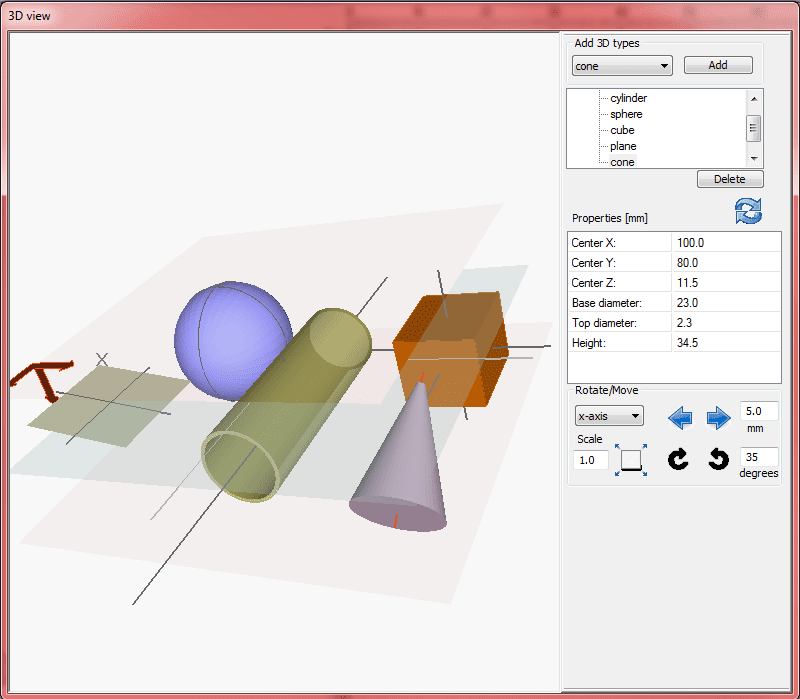
A pop-up window will appear with an options bar on the right and a central screen with an X-Y plane. If we zoom out the screen with the mouse wheel, we can see a square with a white circle that represents the laser and can serve as a reference point.
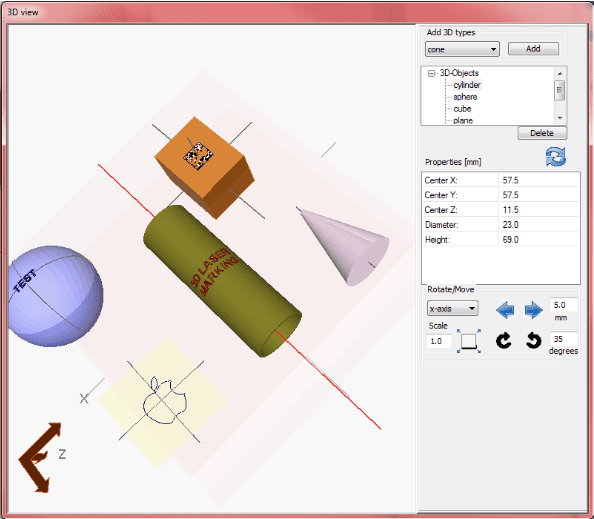
To add a 3D object, we have to select the desired geometric figure (sphere, cone, plane, cylinder...) from the drop-down list at the top right of the pop-up window and press the "Add" button.Figure 2: 3D window in Marca with some selected shapes.
In the toolbar we can see the created shapes and we can view and change their properties.
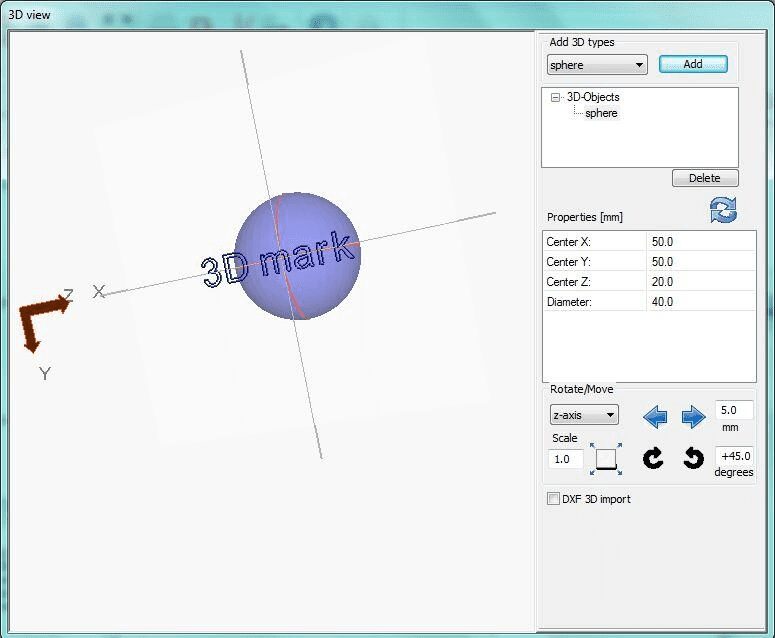
In the standard 2D Brand editor we have to design the message we want to mark on the 3D figure. Once the message is created, if we go inside the 3D popup window, we will see that the message appears in the z = 0 plane. That is, the message is not yet mapped on the figure.Figure 3: 3D window with a message on the z = 0 plane
Next, we must map the 2D message to the 3D figure. Once completed, we can see how the message is mapped on its surface in the 3D window.
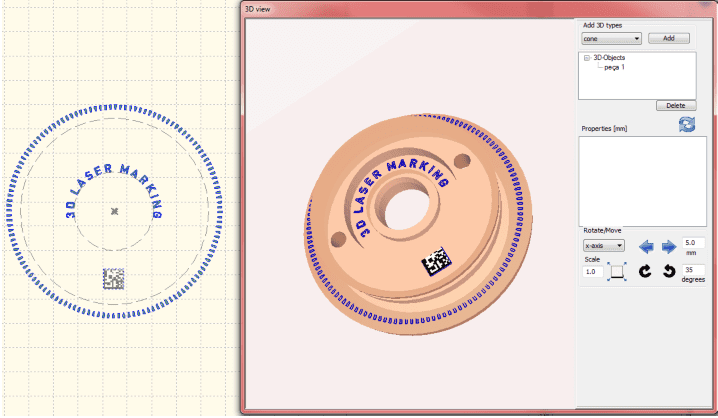
Figure 4: 3D window with different messages mapped on the 3D objects In addition to the range of geometric shapes in the 3D window, it is also possible to import your own STL files (3D shapes) to perfectly map the marking onto the surface of the product.Figure 5: Message created in the standard editor and 3D window with the message mapped onto an imported 3D object
If you are looking for the best laser solution, do not hesitate to contact us:
Optimal coding and traceability solutions for the chemical and paint industry
Macsa id offers coding and traceability solutions for most industrial sectors, including the chemical and paint industries, where several leading companies already use our products.In chemical and paint companies it...
Integra, coding and traceability process optimisation and management in the production industry
For Macsa id, offering a comprehensive service to our customers is essential. That's why, in addition to having the widest range of lasers, along with coding and marking technologies...
Take away detailed information for our SPA range. If you provide your email address, we’ll send contact details of your personal product advisor for any future questions.


 [contact-form-7 id="16985" title="Contact form - Inboud Colours - Post SPARK Catalogo English"]





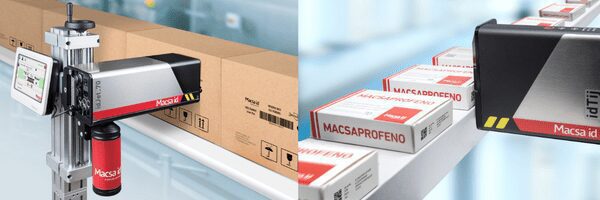
 Empack Oporto 2023 is just around the corner and we are looking forward to sharing our latest solutions in coding and traceability 4.0 with you at the show.