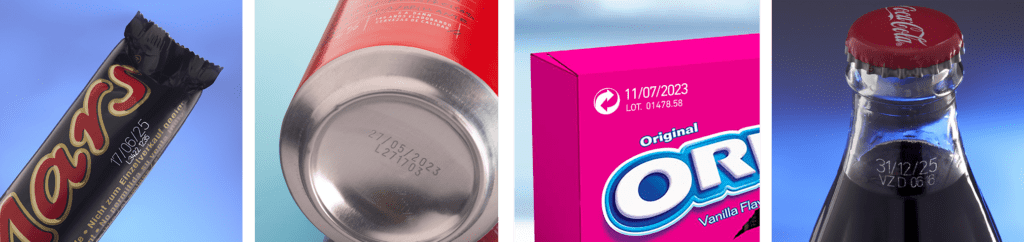
Macsa id offers its customers a wide range of pre-sales and after-sales technical services. This personalised technical assistance aims to respond punctually to any coding, identification and traceability equipment needs that may arise.As a market leader, we believe that committing...
The term 'Green Supply Chain management' (GSCM) refers to the concept of integrating sustainable environmental processes into the traditional supply chain. This can include processes such as product design, material sourcing and selection, manufacturing and production, operation and end-of-life management.
In recent years, research in the area of green manufacturing has extended into green supply chain management. Achieving highly responsive, sustainable supply chain performance is the key to securing a competitive advantage, as well consumer loyalty and long-term business success.
Organizations worldwide are acutely aware of this, but implementing green supply chain management is no simple task. Traditionally, supply chain management has been about cost and quality. Growing concern for the environment has forced a rethink.
In this article you will get an overview of the challenges it involves and Macsa id’s comprehensive solution to get along in this new scene.
Green supply chain management is an approach that integrates eco-friendly methods into traditional supply chain management. Its goal is to reduce the harm incurred at every stage of product creation—purchasing, production, material management, distribution, and logistics.In short, the environmental aspect must be a component in all stages of a product's life, from its design, to its eventual recycling.
The Cycle of Green Supply Chain
2. The challenge with conventional packaging solutions
Conventional print methods struggle to offer brands the flexible and agile solutions they need to meet these varying packaging demands effectively. Traditional manufacturing processes are intended for mass production and require high volume minimum orders of identical boxes, labels, or retail displays to be cost-effective for the brand and the manufacturer.
3. Benefits of using laser printers
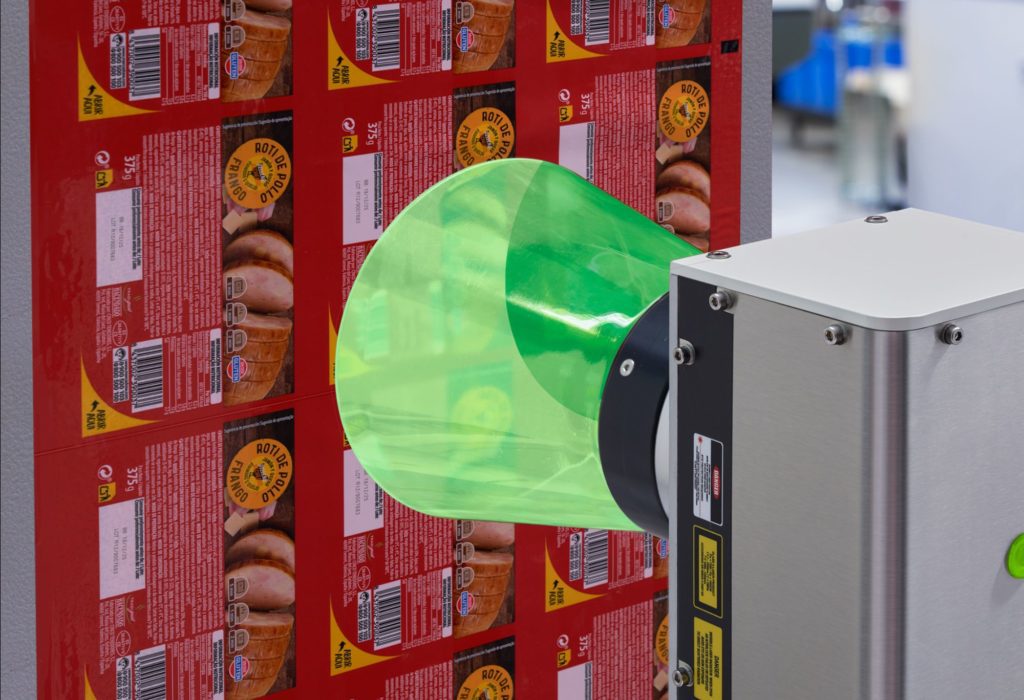
The rising adoption of digital printing and marking technology in food and beverage packaging, consumer goods packaging, and industrial packaging, is propelling the market towards laser printers in the food and FMCG segment.Laser printing provides precise, high-quality text and graphics on various packaging materials. It is an ideal solution when you need custom printed labels for your products, promotional items, on a wide variety of packaging surfaces.Laser markings are completely permanent. They are engraved onto the surface of the item, which is a huge bonus for laser marking.
Laser printers guarantee:
High-quality Print
Precision
Flexibility
Durability
Versatility
Safety
Near-Zero Maintenance
The Macsa id SPA2 Can Coding
4. The Macsa id solution
Macsa id’s packaging lasers achieve high quality marking on any packaging material from cardboard, glass or PET to polystyrene. They require no consumables, making them environmentally friendly and cost effective to run.Macsa id provides laser marking solutions which are compact for production line environments, but also offers modular options for flexible integrated applications, with both options being highly reliable and requiring little maintenance.To explore Macsa id’s range of laser printers just click here.
At Macsa id we will be happy to find the marking, coding and traceability solution that best suits your needs:
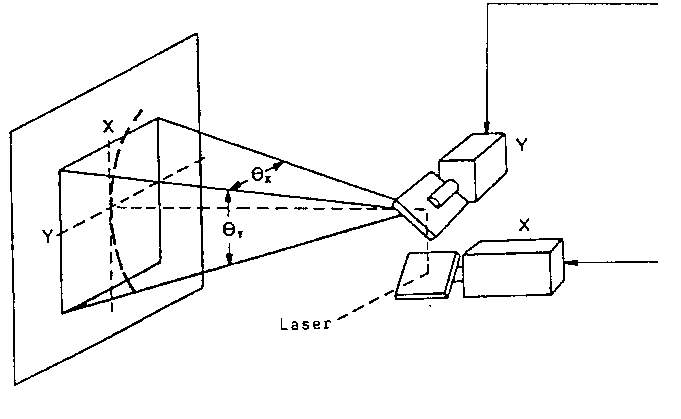
The method that is typically used in laser systems utilizes an optical system of galvanometric scanners. Because the laser beam has no mass, limitations on speed and accuracy are imposed by the movements of the mirrors that guide the laser beam.Beam control is achieved using a set of two X-Y mirrors connected via an axis to the galvanometer scanners, which is in turn controlled by drivers receiving signals from the laser CPU. This provides a pair of polar coordinates converted to Cartesian coordinates by positioning the laser beam in an X-Y plane.The beam exits through the opening of the laser tube and is directed at the marking surface via the mirrors and focal lens.Each movement of the mirrors corresponds to one of the axes (X or Y) and is positioned according to the X-Y coordinates of each of the points of the printed message.These galvanometric scanners have built-in mirrors that reflect the laser beam onto the marking surfaces. The mirrors have a high reflectivity index at the particular laser wavelength to provide maximum beam power.In the case of dynamic marking, the mirrors follow the product as it moves down the production line while the message is being marked. Figure 1: Example of an optical system with galvanometer scanners
2. 3D technology
For 3D marking currently there are different technologies, but these can be divided into 2 main groups: Displacement lenses These optical systems in 3D laser marking heads entail the introduction of a new displaceable lens in addition to one, two or more fixed focal lenses. These lenses are placed in the optical path between the laser tube aperture and the X-Y galvanometric scanners.The usual operation of these systems is as follows:The laser beam exits the laser tube aperture and hits the displaceable lens. The function of this lens is to shift the laser focal spot around the focal plane by moving along an optical axis. This causes a change in the divergence angle of the laser beam.Once the laser beam has passed through the displaceable lens, it passes through one, two or more focal lenses that deal with focusing. It then reaches the laser deflection unit, which is where the X and Y galvanometer scanners are located. As already explained above, the task of the scanners is to guide the laser beam on the X-Y plane.If we focus on the 3D part of the optical path, the part with the new lenses, we can say that when the movable lens approaches the fixed lens, the focal length increases. Conversely, when the displaceable lens moves away from the fixed lens, the focal length decreases.To achieve high performance 3D marking, in addition to having a system with the components explained above, we will need the linear lens shift system to have a number of characteristics.For example, the lens displacement speed performance has to be very high, since the 3 axes (X, Y, Z) have to be coordinated to achieve perfect 3D marking.To attain good performance for linear lens displacement systems, different technologies have been explored. A few of these are explained below:
Galvanometer (Rotary Motor).
It works in the same way as galvanometers that control the motion of X-Y scanners. A galvanometer is based on and works like an electric motor.
Displacement systems can have 2 galvanometers, one on each side for higher speed performance.
Linear actuator (Linear motor)
These are motors that base their operation on the same physical principle as traditional rotary motors, but instead of having a rotary motion they have a linear motion due to the arrangement of their components.
Piezoelectric moto
These motors are considered linear but follow the piezoelectric principle in operation. This principle uses the deformation experienced in some materials when an electric current is applied to them. This deformation is converted into an ultrasonic vibration that moves the motor forwards/backwards.
Voice coil motor
This motor is based on a copper coil energized by an electric current and placed inside a magnetic field generated by permanent magnets. The force generated by the coil is proportional to the magnetic field and to the direction and magnitude of the electric field. As there are no components in contact, there is no wear or friction and it is suitable for high speed applications.
All these linear lens displacement systems will normally be controlled by drivers connected to the central CPU of the laser system.In addition to the above, depending on the application of the 3D laser marking system, an F-Theta lens may or may not be included. The function of these lenses is to ensure the same focal length over the entire marking area. Focus-tunable lens The 3D technology we are going to explain below is based on physical properties to control the Z-axis.The electrically focus-tunable lens is a flexible lens that can change its shape. This lens consists of a polymer membrane surrounded on one side by a type of liquid and on the other side by air. Finally, it is encapsulated by protective glass.The lens works as follows: If the pressure difference between liquid and air is altered by means of an electromagnetic actuator, the radius of curvature of the membrane can change.In the marking head, these tunable lenses are positioned between the laser tube aperture and the X-Y galvanometer scanners. Their function in the optical path is the same as that of the displaceable lens, i.e. to control and change the position of the Zaxis.As in the previous case, depending on the application, an F-Theta lens may or may not be added at the end of the optical path.If it is added, its function is to ensure the smoothing of the marking area and the function of the tunable lens is to change the divergence of the laser beam to achieve a focus shift in the Z-axis.If the F-Theta lens is not added, the two functions discussed above must be performed by the tunable lens.The tunable lens is controlled by a driver connected to the laser system's CPU and allows real-time control in conjunction with the X-Y scanners to achieve perfect 3D marking.
3. Other Z-Axis Control technology
Apart from laser marking for 3D objects, it is sometimes necessary to control the Z-axis but at lower output, for example when marking an object with different planes at different heights.In this application the Z-axis has to go up/down, but it does not have to do it in coordination/real time with the X-Y scanners. In other words, the Z-axis does not have to go as fast as in 3D laser marking systems.For these applications there is also a wide range of technology, but we will describe the most commonly used ones: Focus ShifterThe basic principle of this technology is the same as in 3D displaceable lens laser systems. In fact, the operation and arrangement of the optical components inside the marking head is practically the same.The big difference between these two technologies is, as mentioned above, the performance it gives, so the displaceable lens systems for focus shifters normally use a single galvanometer because the application speeds are much lower. External Z-axisThis technology is different from that described above. As the name suggests, the Z-axis is controlled externally, i.e. outside the marking head of the laser system.This external axis can be implemented in two ways: either an elevator can be positioned to raise/lower the laser or an elevator can be positioned to raise/lower the marking plane and thus the product in question.In this application, the laser focal length is always the same since the laser beam is static in the Z-axis, but it is the external Z-axis elevator that moves up/down.Many laser applications have an external elevator to properly adjust the focal length manually using up/down buttons.For more precise applications, the elevator may be controlled by a servo motor connected directly to the laser CPU to receive position signals.
4. Creation of 3D messages with marca
Marca is Macsa id's own message design software.The software in question has an option for editing and designing messages for 3D shapes.The 3D message design is very similar to the 2D edition. The message to be marked is created with the standard software editor. As in 2D message editing, you can add shapes, text, user messages, images, date or time fields...The difference comes now. In the standard case, when we created the message, we could already save it or print it directly without taking any further steps. In the case of 3D design, once the message is created in the standard Marca editor, we must map the 2D objects created to the surface of the 3D objects. For this reason, first of all, the 3D objects will have to be imported/created in the software.To edit and design a message on a 3D object, follow the steps below:
Once we have the Marca software open we have to press the button.
A pop-up window will appear with an options bar on the right and a central screen with an X-Y plane. If we zoom out the screen with the mouse wheel, we can see a square with a white circle that represents the laser and can serve as a reference point.
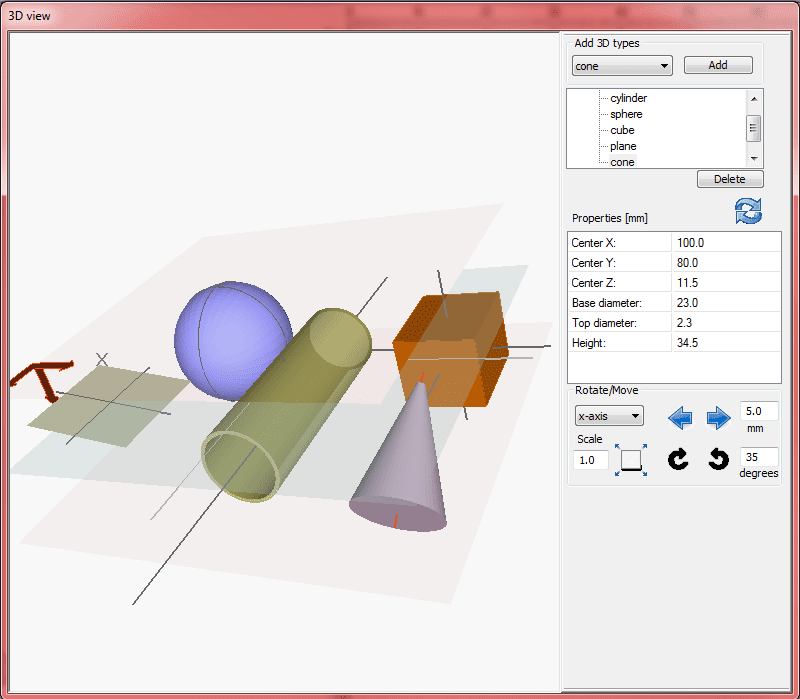
To add a 3D object, we have to select the desired geometric figure (sphere, cone, plane, cylinder...) from the drop-down list at the top right of the pop-up window and press the "Add" button.Figure 2: 3D window in Marca with some selected shapes.
In the toolbar we can see the created shapes and we can view and change their properties.
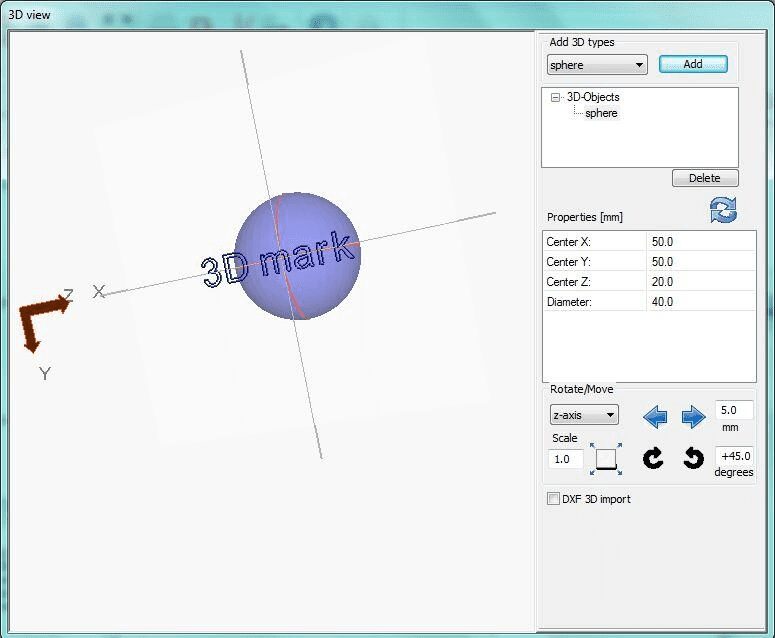
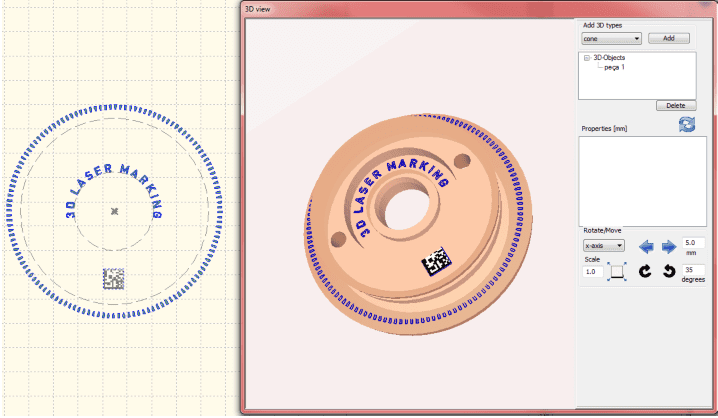
In the standard 2D Brand editor we have to design the message we want to mark on the 3D figure. Once the message is created, if we go inside the 3D popup window, we will see that the message appears in the z = 0 plane. That is, the message is not yet mapped on the figure.Figure 3: 3D window with a message on the z = 0 plane
Next, we must map the 2D message to the 3D figure. Once completed, we can see how the message is mapped on its surface in the 3D window.
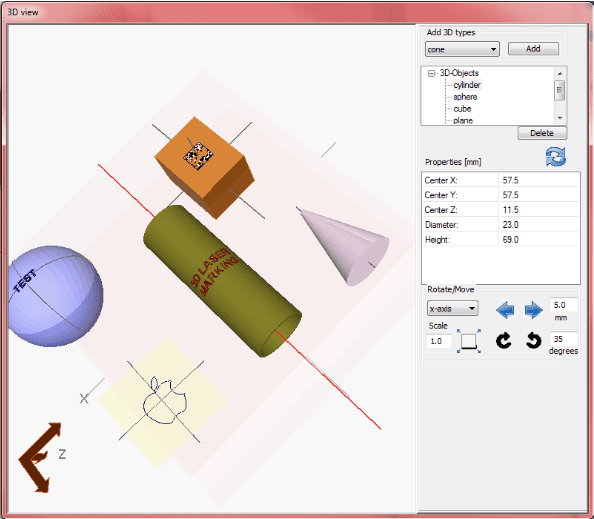
Figure 4: 3D window with different messages mapped on the 3D objects In addition to the range of geometric shapes in the 3D window, it is also possible to import your own STL files (3D shapes) to perfectly map the marking onto the surface of the product.Figure 5: Message created in the standard editor and 3D window with the message mapped onto an imported 3D object
If you are looking for the best laser solution, do not hesitate to contact us:
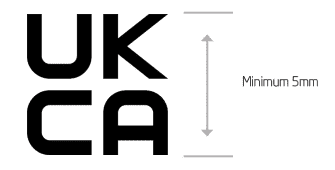
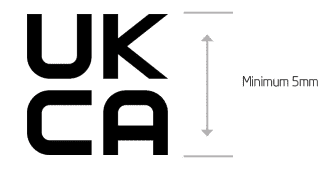
Macsa id provides integral coding and traceability solutions with high contrast and excellent quality results that will help you to comply with the new UKCA mandatory marking requirements.
The UK Conformity Assessed (UKCA) mark is a mandatory mark on certain products, to indicate that they conform to legislation in Great Britain. The marking allows the UK to have control over its goods regulations and maintain high product standards. It replaces the CE and reverse epsilon markings now that the United Kingdom has left the European Union.
2.When should businesses use the UKCA marking?
The deadline for starting to use UKCA marking is 1st January 2023.
3. What kind of products must be marked?
CE and UKCA marking are not applicable for all non-food consumer products. Most UK requirements match the directives and regulations which apply to CE marking. You will need to use the UKCA marking if you manufacture or handle products in the following areas:
Toys
Pyrotechnics
Craft and personal watercraft
Simple pressure vessels
Electromagnetic compatibility
Non-automatic weighing instruments
Measuring instruments
Measuring container bottles
Lifts
Radio equipment
Pressure equipment
Personal protective equipment (PPE)
Gas appliances
Machinery
Equipment for use outdoors
Ecodesign
Aerosols
Low voltage electrical equipment
4. Where should the marking be placed?
In most cases, the UKCA marking must be applied to the product itself or to the packaging. The UKCA marking must be clearly visible, legible and indelible when you affix it to the product. It may sometimes be placed on the manuals or on other supporting literature, but this will depend on the specific regulations that apply to the product.
5. Is Macsa UK already providing this solution?
Among its variety of coding and traceability solutions, Macsa UK has the necessary technology to help your business cope with this new regulation.Macsa id provides marking and coding solutions for products such as bricks, pipes, clay, glass, metal, PVC, wood and many others. The result ensures the finished codes have high contrast and excellent quality, as well as being resistant in harsh work environments.Discover the most versatile range of Macsa Industrial Lasers and Coding & Labelling systems and if you want to know about the latest in coding and traceability, visit our website.
At Macsa id we will be happy to find the marking, coding and traceability solution that best suits your needs:
One of the most important challenges facing the pharmaceutical industry is that of counterfeit medicines. Find out in this blog article how Macsa id can help your company reduce medicines fraud.According to the World Health Organisation (WHO), this type of...
If there is a sector that reflects the evolution that traceability has undergone in recent years, it is the food industry. SP BERNER is a success story in the laser marking of food packaging.All suppliers involved in the supply chain...
Learn more about this Macsa id case study on traceability for filtration solutions for automotive and industrial applications, clean indoor air and sustainable water use.MANN HUMMEL, a success story in traceability for filtration solutions
TABLE OF CONTENTSIntroduction and history of...
Macsa UK will participate at the PPMA Show 2022, a leading UK event for processing and packaging machinery, robots and industrial vision.This exhibition is going to take place from September 27th to 29th at The NEC, Birmingham, UK. More than 350 exhibitors will be providing valuable solutions across all ranges of technology.
Among all the exhibitors, Macsa UK will be at stand D72, showcasing the latest solutions in coding, marking and traceability, such as:
SPA2, which provides a fast and powerful laser, designed to meet the most demanding coding requirements.
ICON3, for 100% sustainable small character coding. Clean, Smart and Affordable. Icon 3 was launched with further improvements to make its installation, utilisation and service even more simple and user-friendly, while ensuring that the laser itself is even more reliable and durable than before.
idJET & idTIJ capable of printing on an extremely wide variety porous materials such as cardboard, paper, wood or also non-porous materials such as metal, aluminum, steel or polystyrene using the idJET UV. It is ideal for large character marking as the head height is 17mm and 70mm. There are different models of idJET covering different market needs to easily adapt to production lines:
Macsa invests 10% of its revenues in R&D&i and it holds patents in more than 30 countries. In addition to developing products and services which enable its customers to be environmentally compliant, it also spearheads the implementation of Industry 4.0. solutions.
Our experts are looking forward to welcoming you at stand D72 and helping you to find the right coding solution for your needs.
To arrange an appointment with Macsa UK team at the PPMA Show 2022, please
Macsa ID equipment is used to code and mark products made from a wide variety of materials, including paper, cardboard, plastics (PET, PVC, HDPE), glass, metals and wood. The messages and graphics that are achieved are of high quality, a minimal operating cost and at high speeds.
Application News demonstrates a sample of products that are coded and marked with Macsa ID lasers, every day and around the world.
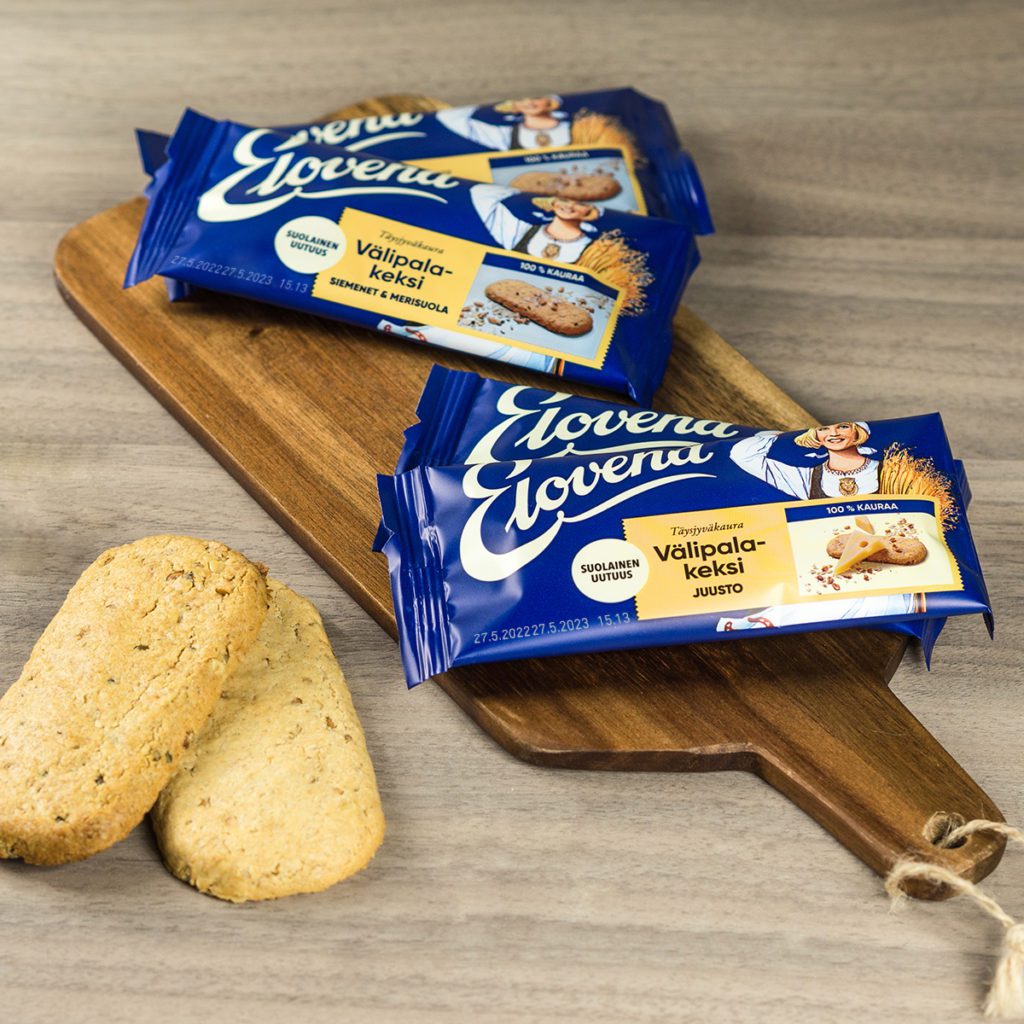
Every time you go to the supermarket to buy some type of "snack" you notice the number of different markings that the packaging contains. Each with a particular characteristic, every marking is adapted to its production speed, pigment colour and will even directly depend on the interior content among others.Today's Application News focuses on how these markings can be carried out and how we adapt what we base the marking parameters on by using the example of a marking made dynamically on the cookie "snack" packaging.
Laser coding on food film
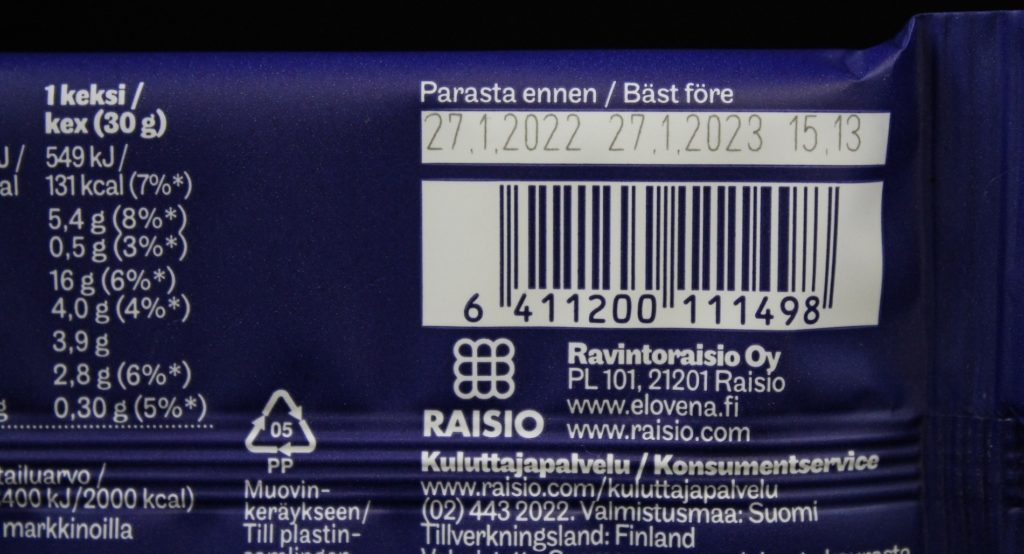
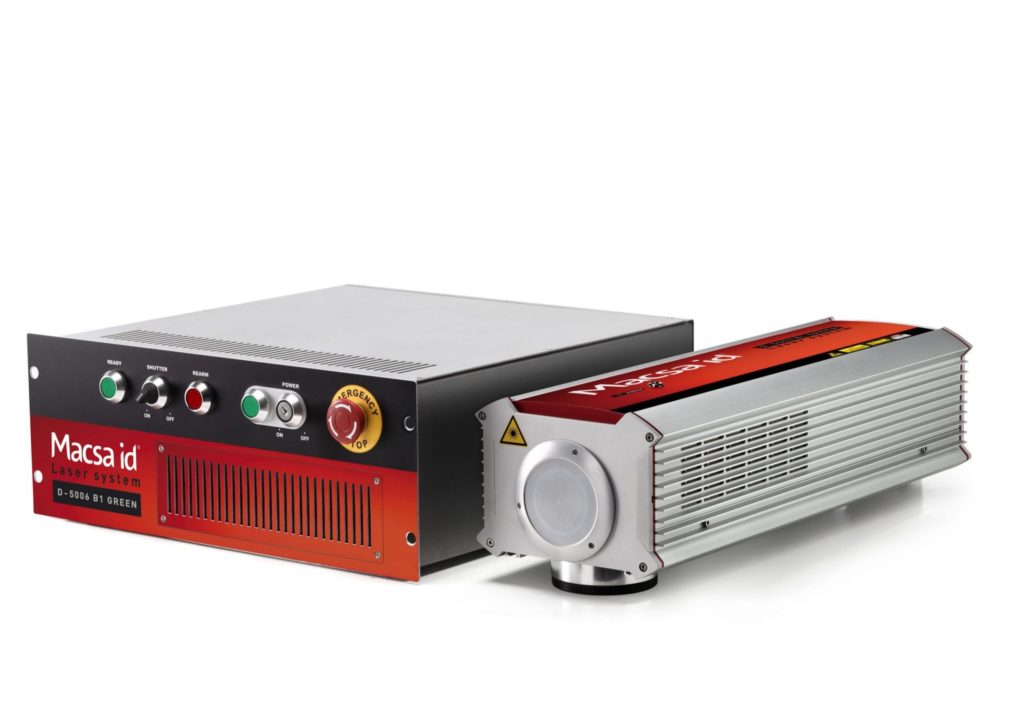
In this type of packaging, it is common to mark a manufacturing date and an expiration date that are easy to read by the consumer when the information is required. To do this, the design of the product must be taken into account so that the marking does not interfere with the visual composition of the packaging.The most suitable laser for today's application is a Macsa id D-5005 Green of 5W power, with a 100x100mm lens. As shown in the photos, it is capable of obtaining the right contrast so as not to damage the container (barrier material) even on irregular surfaces (variable focal length) and with different pigment colours.
Take away detailed information for our SPA range. If you provide your email address, we’ll send contact details of your personal product advisor for any future questions.